
Pruning
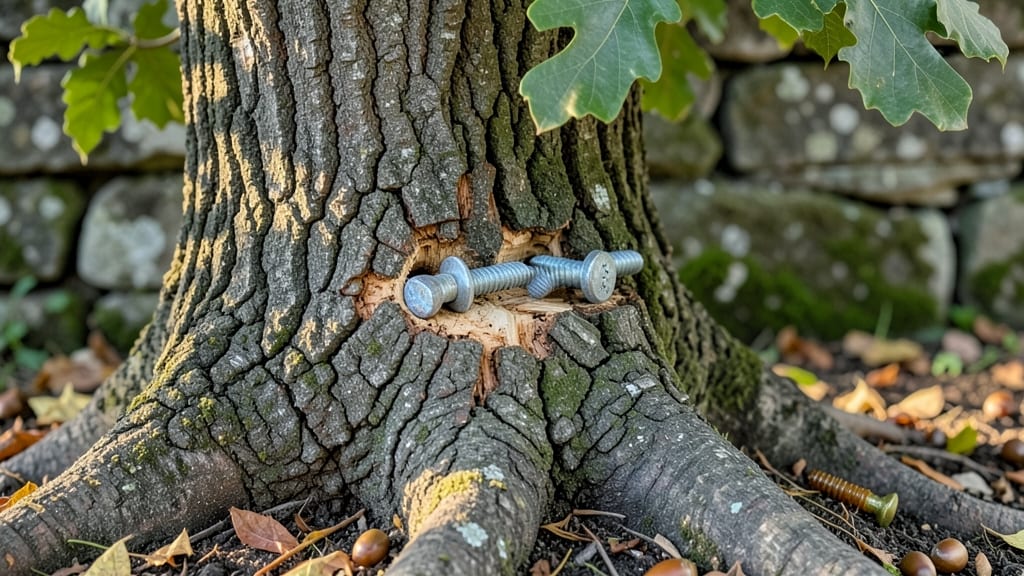
Screwing into a tree damages it by disrupting the bark and cambium layer, which are essential for growth and nutrient transport—but most healthy trees heal over time through natural callus formation and compartmentalization.
When you drive screws into a tree, you're essentially creating an open wound that exposes the living tissue beneath the bark. 🌳 The cambium layer, which acts like a tree's vascular system, gets compromised, slowing down nutrient flow to that area.
However, trees have incredible resilience—many species, like oak or maple, can seal these wounds within a few years through callus growth, effectively "scabbing over" the injury. Younger trees or those already stressed by disease or drought may struggle to heal properly, though.
To minimize harm, always use lag bolts instead of deck screws (they distribute pressure better) and drill pilot holes slightly smaller than the screw diameter. Avoid screwing near the root flare or into sapwood—the heartwood is less active and heals slower.
If you're working with a young tree or one that's already struggling, consider alternative mounting methods like straps or brackets instead.
💡 In This Article
- How Trees Naturally Heal from Screw Wounds
- Best Practices for Screwing Into Trees Without Harm
How trees naturally heal from screw wounds
The healing process begins the moment the bark is penetrated. Trees respond to wounds through a mechanism called compartmentalization, where specialized cells form barriers to isolate the damaged area.
This process starts within the cambium layer, a thin growth layer just beneath the bark that produces new cells for both wood and bark.
When a screw disrupts this layer, the tree rapidly produces callus tissue—a dense, woody growth that seals the wound, much like a scab on human skin.
Fast-healing species like oak or maple can form callus tissue within 1-2 years, completely sealing wounds of moderate size. Their dense wood structure provides natural support during healing.
In contrast, softer woods like pine or willow take 3-5 years or longer, as their less rigid structure struggles to contain the damage. The key difference lies in the tree's ability to compartmentalize—hardwoods excel at this, while softwoods often develop larger, more visible scars.
Temperature and moisture play critical roles in healing. Trees heal fastest in spring and early summer, when active growth is at its peak. During these months, the cambium layer is most active, producing new cells at a rate of about 0.04 inches per day.
Dry conditions slow this process, as the tree diverts resources to maintaining moisture balance rather than wound repair. This is why screwing into a tree during drought stress can delay healing by 50% or more.
What most people don't realize is how the tree's internal plumbing reacts. The phloem (the tree's food transport system) gets damaged, temporarily disrupting sugar flow to that branch. However, the tree reroutes nutrients through adjacent phloem tissues, a process that can take 6-12 months to fully stabilize.
This is why you might see dieback in the branch above a screw wound—the tree is essentially "starving" that section while it rebuilds its transport network.
Visual signs of healing include the formation of a raised, woody ridge around the wound edge (the callus). Over time, this ridge becomes less pronounced as the tree integrates the damaged area back into its structure.
In some cases, you might even see new bark growth emerging from the callus tissue, indicating successful regeneration. The entire process can leave a permanent scar, but for healthy trees, this scar becomes a normal part of their anatomy over time.
Consider this comparison: A 2-inch diameter oak tree can typically handle a 1/4-inch diameter screw with minimal long-term damage, while the same screw in a 1-inch diameter pine sapling could cause permanent stunting.
The tree's age, species, and overall health determine how well it can compartmentalize and heal from the injury.
For those curious about the science, this healing process is governed by the COMPARTMENTALIZATION OF DECAY IN TREES (CODIT) theory, developed by forest pathologist Alex Shigo.
His research shows that trees don't try to "fill in" wounds like we might imagine—they create barriers to contain the damage and redirect growth around it. This biological strategy explains why some trees appear to recover completely while others bear permanent scars.