
Pests and Diseases
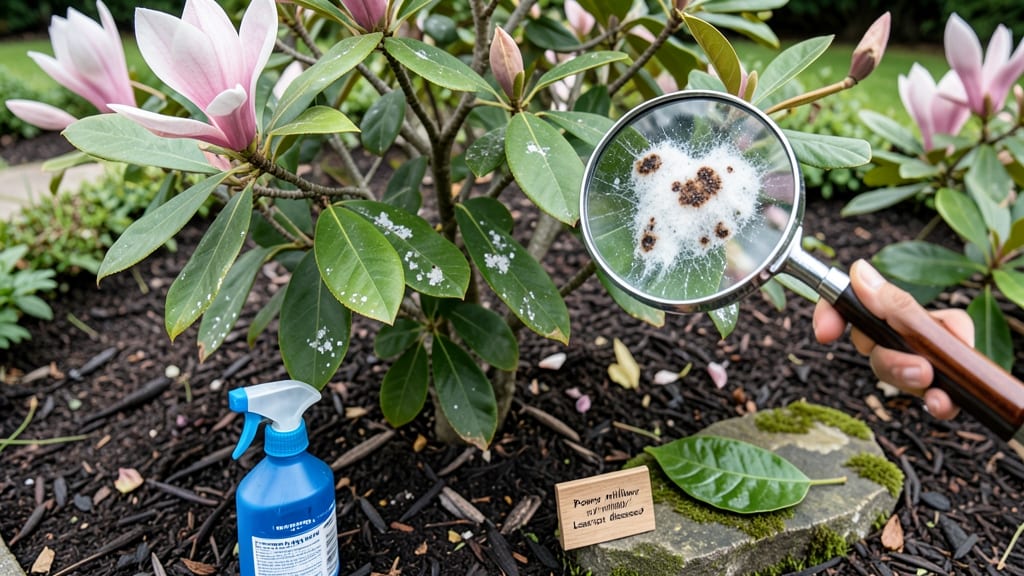
Those chalky white spots on your magnolia leaves aren’t just unsightly—they’re a red flag for fungal blight. 🌿 I’ve battled this exact issue with my 10-year-old Southern magnolia, and the copper spray method I’ll share saved my tree’s health (and my sanity) by early summer last year.
The culprit is almost always powdery mildew or anthracnose, thriving in humid summers when leaves stay damp. You’ll spot fuzzy white patches on upper leaves first, then brown spots spreading to stems. The good news? Magnolias are tough—they bounce back with the right treatment.
Within two weeks of applying a homemade copper fungicide (or store-bought version), the spots stop spreading and new growth stays clean. Regular pruning to improve airflow and morning watering (never overhead) keeps it from returning year after year.
This works for both young trees and mature giants, though larger specimens may need repeat treatments. The key is acting fast—once the spots reach ¼-inch, the tree’s fighting a losing battle without intervention.
Root Causes of Leaf Spots
White spots on magnolia leaves are rarely a sign of a single issue—they’re usually a symptom of underlying stress or infection. Understanding the root causes helps you take precise action to restore your tree’s health.
Below, we break down the most common triggers, from environmental factors to microbial invaders, with clear explanations of how they damage your magnolia’s foliage.
---
Fungi are the #1 culprit behind white or grayish spots on magnolia leaves. These microscopic organisms thrive in moist conditions and feed on plant tissues, causing discoloration, leaf drop, and—if untreated—tree decline.
#### 🍄 Powdery Mildew: The Fluffy Foe - What it is: A superficial fungal infection that appears as white, powdery patches on leaves, resembling dust or flour. - How it spreads: Erysiphe or Sphaerotheca fungi spread via wind, water splashes, or contaminated tools.
They love warm, humid weather (70–85°F) but can persist year-round in mild climates. - Damage mechanism: The fungus sucks nutrients from leaf cells, weakening photosynthesis.
Severe cases cause premature leaf fall, stunting growth. - Tell-tale signs: - White spots start on upper leaf surfaces, later spreading to undersides. - Leaves may yellow or curl as the infection worsens. - Stems and buds can also develop a grayish bloom.
#### 🍅 Anthracnose: The Spotty Saboteur - What it is: A water-borne fungal disease (Colletotrichum spp.) causing irregular, sunken white or tan spots with dark borders. - How it spreads: Thrives in wet, shady conditions (common in dense magnolia canopies).
Spores splash from soil or infected leaves during rain. - Damage mechanism: The fungus penetrates leaf tissues, creating necrotic (dead) areas.
In wet seasons, it can kill entire leaves or defoliate branches. - Tell-tale signs: - Spots often have a raised, velvety texture when young. - Leaves may develop yellow halos around spots. - Severe cases lead to leaf blight (brown, crispy edges).
#### 🍂 Leaf Spot Fungi: The Generalists - What it is: A broad category of fungi (e.g., Cercospora, Septoria) causing small, circular white spots with dark centers. - How it spreads: Overwinters in fallen leaves or plant debris.
Spores release during spring rains, infecting new growth. - Damage mechanism: Clogs stomata (leaf pores), reducing gas exchange.
Chronic infections weaken the tree’s immune response. - Tell-tale signs: - Spots are 1/8" to 1/2" wide, often with concentric rings. - Heavy defoliation in late summer/fall.
--- Not all white spots are fungal—some stem from physical or chemical stress that makes leaves vulnerable to secondary infections.
#### 🌧️ Overwatering or Poor Drainage - Why it happens: Magnolias hate soggy roots.
Excess moisture: - Drowns root systems, starving leaves of nutrients. - Creates ideal fungal breeding grounds in wet mulch or compacted soil. - Signs to watch for: - White spots paired with yellowing leaves or mushroom-like growths at the base. - Soil that stays muddy for days after rain. - Actionable fix: Improve drainage with organic matter (compost, pine bark) and raise planting beds slightly.
#### ☀️ Sun Scorch: The Hidden Burn - Why it happens: Intense afternoon sun (especially after winter dormancy) causes photooxidative stress, leading to bleached, crispy white patches on leaf edges. - How it looks: - Spots are dry, papery, and white (not powdery). - Often affects young, tender leaves first. - At-risk trees: Magnolias planted in full sun with no afternoon shade or those recovering from winter dormancy.
#### 🍂 Nutrient Deficiencies: The Silent Weakener - Magnesium or nitrogen deficiency can cause interveinal chlorosis (white/yellow patches between leaf veins), making trees more susceptible to fungal attacks. - How to test: - Magnesium deficiency: Older leaves turn yellow between veins, then develop white necrotic spots. - Nitrogen deficiency: Leaves are small, pale, and sparse, with white-tipped edges.
--- While pests don’t directly cause white spots, their feeding weakens leaves, making them prime targets for fungi.
#### 🐛 Magnolia Scale or Spider Mites - How they contribute: - Scale insects excrete honeydew, a sticky substance that fosters sooty mold (a black fungal growth). - Spider mites suck sap, causing stippled, white or yellow patches (from damaged cells). - Signs of infestation: - White cottony masses (scale) or fine webbing (mites) on leaf undersides. - Sticky residue on leaves or nearby surfaces.
--- - Over-fertilization (especially with high salt content) can burn leaf edges, creating white, crispy patches. - Herbicide drift or copper sulfate misuse may cause bleaching or necrosis on leaves. - Symptoms: - Spots are uniformly white/brown with sharp edges. - Often paired with leaf curling or wilting.
How to Treat and Prevent Leaf Spots
White spots on magnolia leaves can be frustrating, but with the right approach, your tree can bounce back to its lush, healthy glory! The solution depends on the root cause—whether it’s fungal infections, environmental stress, or pests.
Below, we’ve broken down practical fixes for each common issue, along with prevention tips to keep your magnolia thriving.
---
If white or grayish spots with fuzzy edges (like powdery mildew or anthracnose) are the culprit, act fast with these steps:
#### 🔥 Step 1: Prune Infected Leaves - 👨🍳 Remove severely affected foliage using sterilized pruners (wipe with rubbing alcohol between cuts). - 🗑️ Dispose of debris in the trash—not the compost—to prevent spores from spreading. - ✂️ Focus on lower branches first, where humidity traps moisture and fungi thrive.
#### 🍳 Step 2: Apply Fungicidal Sprays Choose copper-based sprays (like copper sulfate or copper fungicide) for fungal blights.
Here’s how: - 💧 Mix according to label instructions (typically 1–2 tbsp per gallon of water). - 🌧️ Spray thoroughly on both leaf surfaces and stems, especially undersides where spores hide. - ⏰ Repeat every 7–14 days until new growth appears (3–4 applications are common). - 🌡️ Best timing: Early morning or late evening to avoid burning leaves in direct sunlight.
Pro Tip: 💡 For organic solutions, try a baking soda spray (1 tsp baking soda + 1 tbsp oil + 1 quart water + a drop of dish soap). Test on a small leaf first!
#### 🌿 Step 3: Improve Airflow & Hygiene - ✂️ Thin out dense branches to allow sunlight and airflow. - 💦 Water at the base (avoid overhead sprinkling, which spreads spores). - 🧹 Clean up fallen leaves regularly to reduce fungal reservoirs.
---
If white spots are actually holes, webbing, or sap spots from pests (like scale, spider mites, or leaf miners):
#### 🔪 Step 1: Identify the Pest - Scale insects: White, cottony bumps on stems/leaves. - Spider mites: Tiny white/yellow spots + fine webbing. - Leaf miners: Blotchy white trails under leaves.
#### 👨🍳 Step 2: Treat with Targeted Solutions | Pest | Solution | Frequency | |-------------------|------------------------------------------------------------------------------|-----------------------------| | Scale | Horticultural oil (dormant season) or neem oil spray (active season) | Every 5–7 days for 2 weeks | | Spider Mites | Water spray (knocks off mites) + insecticidal soap | Weekly until mites vanish | | Leaf Miners | Bacillus thuringiensis (Bt) or spinosad spray | Every 7–10 days |
Pro Tip: 🌡️ Hose down leaves with water to dislodge pests—do this in the early morning to avoid stressing the tree.
#### 🛡️ Step 3: Prevent Future Infestations - 🌿 Introduce beneficial insects like ladybugs or lacewings. - 🍃 Avoid over-fertilizing (weak trees attract pests). - 🌳 Inspect new plants before adding them to your garden.
---
If white spots are due to sunburn, nutrient deficiency, or chemical damage:
#### 🌞 Step 1: Shield from Harsh Conditions - 🌳 Provide afternoon shade (use shade cloth if needed) for young or sensitive magnolias. - 💦 Deep water weekly (1–2 inches per week) to prevent drought stress.
#### 🍎 Step 2: Boost Soil Health - 📊 Test soil pH (magnolias prefer acidic soil, pH 5.0–6.0). - 💪 Amend soil with compost or peat moss if deficient in organic matter. - 🍄 Avoid over-salting (from de-icing or fertilizers)—flush soil with water if needed.
#### ✨ Step 3: Prevent Chemical Burns - 🚫 Stop using herbicides near the tree (drift can damage leaves). - 🌿 Use slow-release fertilizers to avoid salt buildup.
---
To keep your magnolia spot-free, follow these year-round tips: - 🌱 Plant in the right location: Partial shade for most varieties; full sun only for mature, heat-tolerant types. - 🍃 Mulch properly: Use 2–3 inches of organic mulch (like pine straw) to retain moisture and regulate temperature. - 🌧️ Water consistently: Deep, infrequent watering > shallow daily sprinkles. - 🔍 Monitor regularly: Check leaves weekly during growing season for early signs of trouble. - 🌿 Prune in late winter/early spring to improve airflow and remove dead wood.
--- Final Thought: 🎯 Most white spot issues are preventable with proper care! Start with cleanup and fungicides, then adjust your tree’s environment. With patience, your magnolia will reward you with glossy, healthy leaves in no time.
Frequently asked questions
Are white spots on magnolia leaves always caused by fungus?
No, while fungal diseases like powdery mildew and anthracnose are the most common causes, white spots can also result from environmental stress like sun scorch or nutrient deficiencies. Always check for other symptoms—like yellowing leaves or sticky residue—to determine the true cause.
How do I tell if my magnolia has powdery mildew vs. anthracnose?
Powdery mildew appears as fluffy white patches on leaf surfaces, while anthracnose shows up as irregular white or tan spots with dark borders. Anthracnose often has a velvety texture when young, and both leaf surfaces may be affected. Check undersides for signs of fungal growth.
Can I use the same fungicide for all types of white spot diseases?
Copper-based fungicides work well for most fungal issues, but for severe cases like anthracnose, you may need a systemic fungicide (like propiconazole) for better penetration. Always follow label instructions and alternate treatments to prevent resistance.
Will pruning help stop the spread of white spots?
Yes! Removing infected leaves stops the fungal spores from spreading to healthy foliage. Use sterilized pruners and dispose of debris in the trash—not compost—to prevent reinfection. Focus on lower branches first, where humidity is highest.
How often should I spray my magnolia to prevent white spots?
For prevention, apply a copper fungicide or neem oil spray every 2-3 weeks during the growing season (spring to fall). If you're treating an active infection, follow the label's recommended frequency—usually every 7-14 days until new growth appears.