
Plants
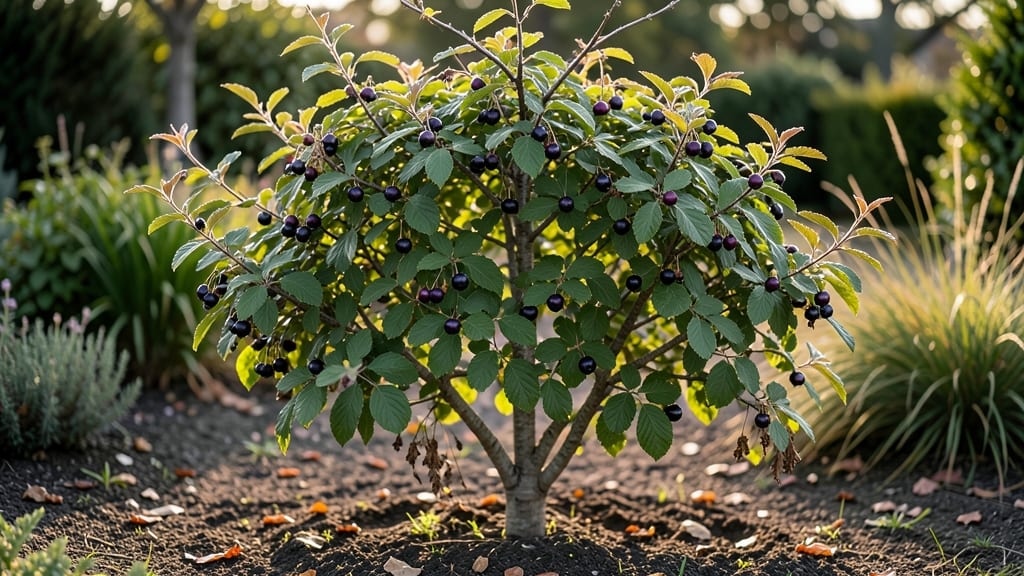
A chokeberry tree looks like a compact shrub or small tree with glossy oval leaves, smooth gray bark, and glossy red berries that darken to deep purple-black when fully ripe. It grows upright and rounded, typically reaching between 6 and 12 feet in height.
A chokeberry tree stands out with its dense, bushy foliage and distinctive berry clusters that hang like tiny ornaments. 🌿 The leaves are oval-shaped with serrated edges and a rich green hue, while the bark remains smooth and grayish-brown throughout the year.
Unlike some fruit trees, chokeberries don't produce showy flowers—instead, they focus on their striking berries, which stay on the branches well into winter before dropping. This makes them easy to spot even from a distance, especially when their berries contrast against the dark green leaves.
The tree's upright, rounded shape gives it a neat, almost manicured appearance, making it a popular choice for hedges or ornamental plantings. While it shares some similarities with hawthorn or dogwood trees, chokeberries have a more compact growth habit and lack the thorns that many other berry-producing shrubs develop.
Their berries also have a unique tart, almost astringent flavor when raw, which sets them apart from sweeter fruits like blackberries.
💡 In This Article
- Identifying Chokeberry Tree Leaves, Bark, and Growth Habit
- Chokeberry Tree Fruit and Seasonal Characteristics
Identifying chokeberry tree leaves, bark, and growth habit
The chokeberry tree's leaves are its first visual clue—oval-shaped with a glossy, dark green surface that reflects light slightly, almost like polished mahogany. Each leaf measures about 1-3 inches long and 0.5-1.5 inches wide, with finely serrated edges that create a delicate, almost lace-like appearance when viewed closely.
The veins form a subtle network, with the central vein slightly more prominent than the side veins, creating a subtle ribbed texture you can feel if you run your fingers along the underside.
The bark is another distinctive feature, remaining smooth and grayish-brown throughout the tree's life, unlike many fruit trees that develop rough, fissured bark as they age. Young chokeberry trees have bark that's almost silvery-gray, while mature specimens develop a slightly darker, more muted tone.
This smooth bark contrasts sharply with trees like hawthorn, which develop prominent thorns and rougher bark texture, or dogwood, which has more textured, diamond-patterned bark as it matures. 🌿 The lack of thorns also sets chokeberries apart from many ornamental shrubs, making them safer for gardens where children or pets might play.
Chokeberry trees grow in a compact, upright form that typically reaches 6-12 feet tall and spreads 5-8 feet wide, creating a dense, rounded canopy. The branching structure is multi-stemmed, meaning several main trunks emerge from the base rather than a single central trunk.
This growth pattern makes them ideal for hedges or privacy screens, as they develop quickly and maintain their shape with minimal pruning. In comparison, dogwood trees often have a more pyramidal shape, while hawthorn tends to be more sprawling with irregular branching.
The tree's dense foliage creates a nearly impenetrable screen when mature, with leaves that stay attached well into late fall before turning a brilliant yellow or orange before dropping. This extended leaf retention is unusual for many fruit-bearing trees, which often shed leaves earlier in the season.
The combination of glossy leaves, smooth bark, and compact growth habit makes chokeberry trees instantly recognizable once you know what to look for—especially when their distinctive berries appear in late summer.
One fascinating botanical detail is how the leaves' glossy surface helps repel water, reducing fungal diseases that plague many fruit trees. This natural adaptation explains why chokeberries thrive in damp conditions without developing the leaf spots or mildew that affect similar-looking shrubs.
The serrated edges also create tiny air pockets that improve gas exchange, helping the leaves maintain their vibrant green color even in less-than-ideal growing conditions.
For visual comparison, imagine standing next to a chokeberry tree versus a hawthorn: the chokeberry's leaves are smoother and less jagged, its bark lacks thorns, and its overall form is more uniform.
Dogwood trees, while similar in height, have more horizontal branching and distinctly different leaf shapes—often with more pronounced veins and a lighter green color. These subtle differences become obvious once you examine the trees side by side in their natural habitat.