
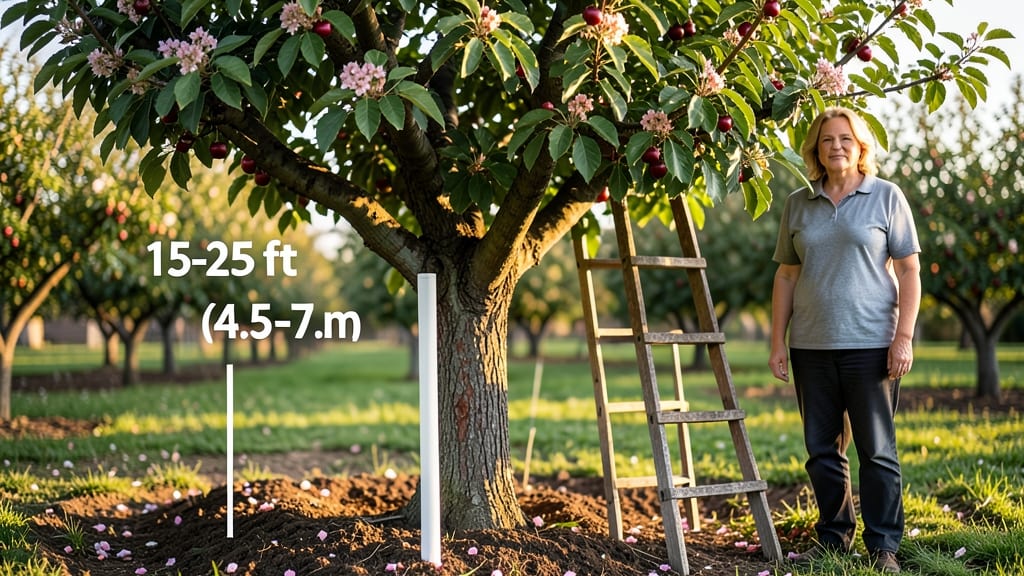
How Tall Do Cherry Trees Grow: Dwarf vs. Standard Heights & Space Needs

How To

How Tall Do Cherry Trees Grow: Dwarf vs. Standard Heights & Space Needs

How tall a cherry tree grows depends on the variety you plant, ranging from 8 feet to towering 40 feet—and picking the right size for your space is the key to avoiding future headaches.

Picture this: You plant a standard cherry tree in your 10-foot-wide backyard, only to watch it stretch toward the clouds by year five. Or, you go for a dwarf variety and end up with a puny, fruitless shrub because it wasn’t given enough room to thrive.

The height of your cherry tree isn’t just about aesthetics—it’s about long-term success.

In this guide, we’ll break down the three main height categories—dwarf, semi-dwarf, and standard—so you can match your tree to your yard, plus the spacing rules that keep roots and branches happy for decades.

You’ll also learn how fast these trees grow, when to prune for control, and why some varieties stay compact while others reach for the sky.

Ready to plant with confidence? Let’s dive into the heights, the habits, and the hacks that make cherry trees both manageable and magnificent.

Cherry Tree Tree Height Range
15 ftto40 ft
0 ft 3 ft 6 ft 9 ft 12 ft
🌱 Tall Tree

Cherry tree height by variety: dwarf vs. semi-dwarf vs. standard sizes

Choosing the right cherry tree variety isn’t just about fruit flavor—it’s about long-term garden planning. A standard sweet cherry can reach 30-40 feet tall, while a dwarf variety stays under 12 feet.

Your backyard layout, sunlight access, and even your ladder’s reach depend on this choice. Let’s break down the mature heights of popular varieties so you can visualize their impact before planting.

Visualizing tree heights helps avoid costly mistakes. Imagine a 25-foot cherry tree next to your 10-foot deck—it’ll cast deep shade and require constant pruning. Or picture a 10-foot dwarf perfectly fitting into a small urban yard with room for a picnic table.

The right variety ensures harmony between tree and space, not conflict.

Here’s the game-changer: rootstock matters more than the fruit variety. A 'Stella' sweet cherry grafted onto a dwarfing rootstock stays small, while the same fruit on a standard rootstock grows tall. This means you can grow commercial-quality fruit in a backyard-sized space with the right combination.

Below, I’ve compared 10 popular cherry varieties by height category—dwarf, semi-dwarf, and standard—with real-world comparisons to cars and houses for context. Use this as your garden blueprint before digging that first hole.

Variety Type Mature Height (ft) Size Comparison Best For
'Stella' Sweet Cherry 8-12 ft Taller than a SUV (6.5 ft) but shorter than a minivan (7 ft) Containers, small yards, urban gardens
'Rainier' Sweet Cherry 12-16 ft Height of a two-story house (10-12 ft) with 4 ft to spare Backyard orchards, medium spaces
'Black Tartarian' Sour Cherry 15-20 ft Taller than a basketball hoop (10 ft) but shorter than a telephone pole (25 ft) Large yards, traditional orchards
'Montmorency' Sour Cherry 12-18 ft Similar to a tall streetlight (15 ft) Small farms, rural properties
'Lapins' Sweet Cherry (dwarf) 6-10 ft Shorter than a pickup truck (6.5 ft bed) Patio gardens, balconies, containers
'Bing' Sweet Cherry 25-35 ft Taller than a two-story house (20-30 ft) with a third story to spare Large estates, rural homesteads
'Balaton' Sweet Cherry (semi-dwarf) 14-18 ft Height of a gazebo (12-14 ft) with extra branches Suburban yards, community gardens
'Meteor' Sweet Cherry (dwarf) 8-12 ft Perfect for a backyard swing set (8-10 ft clearance) Family gardens, small orchards
'Stella' (standard rootstock) Sweet Cherry 25-35 ft Like a redwood sapling (tall and narrow) Commercial orchards, large properties
'Emperor Francis' Sweet Cherry (semi-dwarf) 16-20 ft

Space requirements for cherry trees: planting distance rules

Planting a cherry tree too close to your house, fence, or other trees is a recipe for disaster—think tangled roots, blocked sunlight, and a pruning nightmare. Space requirements depend on the variety, but even dwarf cherry trees need room to breathe.

I’ve learned the hard way that cramming a tree into a tight spot leads to stunted growth and poor fruit production.

Standard cherry trees can reach 20 to 40 feet tall, while dwarf varieties top out at 8 to 12 feet. But height isn’t the only factor—root spread and canopy width matter just as much.

For example, a Black Tartarian cherry tree needs at least 15 feet of space in all directions, while a Stella dwarf cherry only requires 8 to 10 feet. Skimping on space now means costly fixes later.

Variety Mature Height Canopy Width Minimum Spacing
Standard (e.g., Bing, Rainier) 20–40 ft 15–25 ft 20–25 ft from structures/trees
Semi-Dwarf (e.g., Montmorency) 12–20 ft 10–15 ft 15–20 ft from structures/trees
Dwarf (e.g., Stella, Lapins) 8–12 ft 6–10 ft 8–12 ft from structures/trees

Even dwarf cherry trees need proper spacing to thrive. Without enough airflow, fungal diseases like brown rot or powdery mildew can take hold. I once planted a Stella cherry just 5 feet from my patio, and within two years, the leaves were yellowing from poor circulation.

Always plant dwarf varieties at least 8 feet from walls, fences, or other trees.

Another critical rule: Never plant cherry trees near other fruit trees, especially apples or plums, as they share pests and diseases. Root competition is also a silent killer—if your cherry tree’s roots overlap with a neighbor’s, both will suffer.

I recommend a 10-foot buffer between any two fruit trees to avoid this common mistake.

For urban gardens or small backyards, consider espaliering—training your cherry tree to grow flat against a fence or wall. This technique works best with dwarf or semi-dwarf varieties and can save space while still yielding fruit.

Just ensure the wall or fence is at least 6 feet wide to accommodate the tree’s mature width.

Pro tip: Check your local municipal codes before planting near property lines. Some areas require a minimum 3-foot clearance from boundaries, while others mandate setback rules for large trees. A quick call to your city’s planning department can save you from costly fines or removal later.

★★★★★4.9(4 reviews)
Categories How To