
Pruning
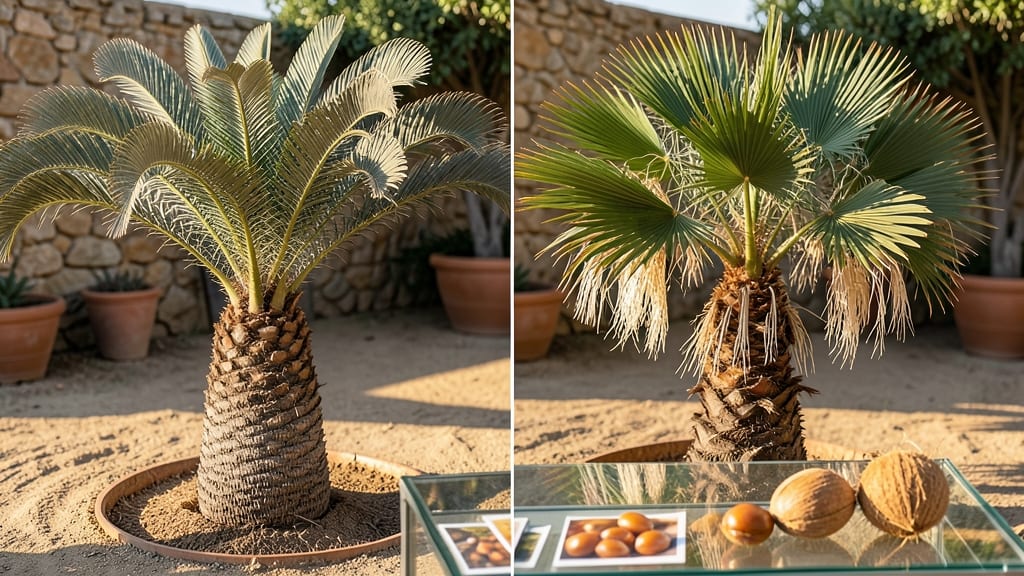
Palm trees and date trees aren't the same: date palms (Phoenix dactylifera) are a single species known for producing sweet, edible dates, while 'palm tree' refers to over 2,600 diverse tropical species with varying appearances and ecological functions.
While both belong to the palm family, date palms are specialized for fruit production, featuring distinctive feather-shaped leaves and deep root systems optimized for arid climates. 🌵 Ornamental palms, like the popular coconut or royal palm, focus on aesthetics or ecological roles rather than food production.
The key difference lies in their reproductive structures—date palms develop clusters of edible fruit, whereas most other palms produce inedible or decorative seed pods.
Date palms thrive in hot, dry regions and require specific care to produce fruit, while many ornamental palms adapt to various climates and serve primarily as landscape features. This distinction explains why you'd never find a date palm in a tropical beach resort setting, despite their shared botanical family.
💡 In This Article
- Botanical Differences Between Date Palms and General Palm Trees
- Growing and Harvesting Date Palms vs. Ornamental Palm Trees
Botanical differences between date palms and general palm trees
Date palms (Phoenix dactylifera) belong to the Arecaceae family, but they're just one specialized species among over 2,600 palm varieties.
The key distinction starts with their leaf structure: date palms have feather-shaped fronds with 100-150 leaflets, while many ornamental palms feature fan-shaped leaves (like the sago palm) or different arrangements.
This structural difference affects their growth patterns—date palms develop a single, unbranched trunk that can reach 100 feet tall, whereas palms like the coconut grow in clustered trunks or multiple stems.
The root systems tell another story. Date palms develop deep, extensive root networks that spread up to 50 feet wide, allowing them to access groundwater in arid climates. In contrast, ornamental palms often have shallower, less extensive roots suited for tropical rainforests.
Their reproductive biology also differs dramatically: date palms produce clusters of 100-1,000 dates per fruit bunch, while most other palms bear inedible seed pods or flowers that lack commercial value. 🌱 The date palm's inflorescence (flower cluster) is particularly unique, containing both male and female flowers on the same plant—a rare trait in palms called "monoecious."
What makes date palms stand out botanically is their double-sampling growth habit: they produce two types of leaves—sterile fronds for photosynthesis and fertile fronds that develop into fruit. This dual-purpose leaf system is absent in most ornamental palms, which allocate all their energy to foliage or structural growth.
The date palm's fruit itself contains three layers: the outer skin (exocarp), the fleshy mesocarp, and the hard endocarp surrounding the seed—an anatomical complexity rare in palm fruits.
Another fascinating difference lies in their pollination mechanisms. Date palms rely on wind and insect pollination, while many ornamental palms depend on specialized beetles or bats.
This biological specialization explains why date palms can thrive in desert oases where other palms would fail—their reproductive strategy is perfectly adapted to arid conditions with limited water availability.
The date palm's ability to photosynthesize efficiently under high temperatures (up to 120°F) further cements its ecological niche as a survivor in harsh environments.
Consider the coconut palm (Cocos nucifera) as a prime example of botanical contrast. While both are iconic palms, coconuts produce single-seeded drupes with fibrous husks, whereas date palms yield stone fruits with sweet, fleshy interiors.
The coconut's water-filled endosperm makes it a survival tool for floating seeds, while date palms prioritize nutrient-rich fruit for animal dispersal in desert ecosystems. This fundamental difference in reproductive strategies shapes their entire growth cycle and ecological role.
For those curious about identification, look at the leaf bases: date palms retain old leaf bases that form a ringed trunk**, while many ornamental palms shed these bases cleanly. The date palm's spiny leaf margins also set it apart from smoother-leaved varieties like the majesty palm.
These visual cues help distinguish date palms from their ornamental cousins at a glance. 🌵