
Planting
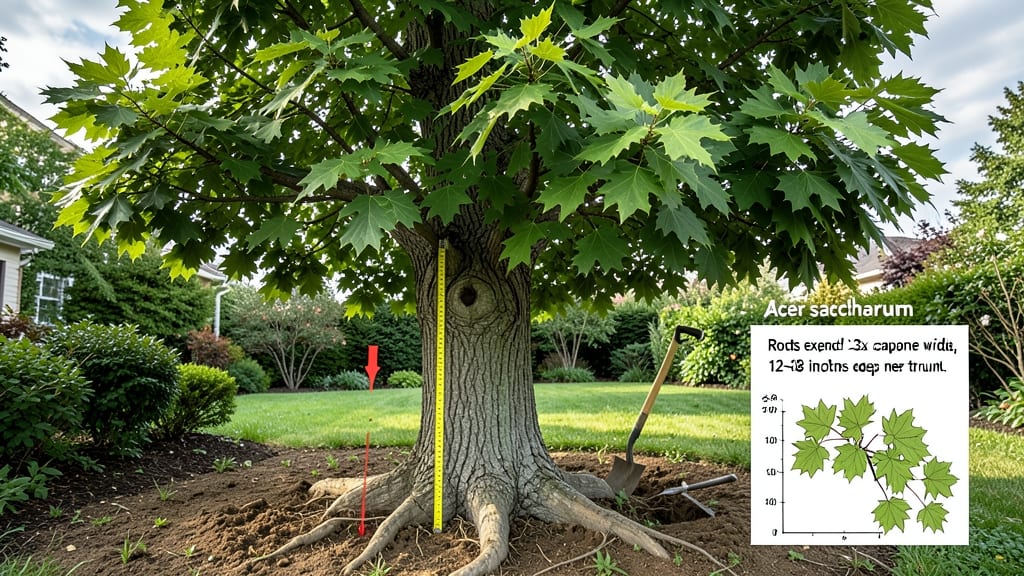
Maple tree roots spread far wider than they grow deep, often reaching 3 to 5 feet down but extending 2 to 3 times the tree’s height outward—which is why your driveway might be at risk before you even notice.
Wondering if your new maple tree will crack your driveway or invade your neighbor’s yard? Understanding maple tree root depth and spread is critical for safe planting and long-term landscaping success.
Most people assume roots grow straight down, but maple trees develop a wide, shallow network that can damage sidewalks, foundations, and even underground pipes if not accounted for early.
Below, I break down the exact root patterns by species, how close you can plant near them, and 5 warning signs that roots are already causing trouble—so you can protect your property before it’s too late.
Maple tree root depth by species: how far down they grow
Maple trees are stunning additions to any landscape, but their root systems can be surprisingly aggressive. While many assume maple roots grow straight down like a taproot, most species develop extensive lateral roots that spread horizontally.
Understanding these patterns helps you avoid costly driveway cracks or neighborly disputes. Let’s break down how deep each species grows and how soil type influences their spread.
Contrary to popular belief, mature maple trees rarely develop a single dominant taproot. Instead, they form a complex network of fibrous roots that spread outward.
The depth and spread vary significantly between species, with some roots reaching 3-5 feet deep while others spread 2-3 times wider than the tree’s canopy. This variation is why proper spacing and soil prep are critical before planting.
Soil type plays a huge role in root development. Clay soils force roots to grow deeper in search of moisture, while sandy soils encourage wider, shallower spread. Loamy soils—ideal for maples—provide the perfect balance, allowing roots to establish both depth and lateral reach.
Always test your soil before planting to ensure optimal root growth patterns.
Here’s a detailed comparison of root depth and spread for the three most common maple species:
The sugar maple is the most balanced of the three, with roots that penetrate 3-5 feet deep while still spreading widely. This makes it ideal for urban landscapes where space is limited but proper soil prep is possible. Its fibrous root system helps stabilize soil, reducing erosion risks in gardens.
If you’re planting a silver maple, be prepared for its aggressive lateral spread. These roots can extend 3-5 times wider than the tree’s canopy, making them a poor choice near driveways or sidewalks.
Silver maples thrive in moist soils and are often found near ponds or streams, where their roots can access water easily.
For red maple enthusiasts, expect a hybrid system: a deep taproot combined with extensive laterals. This dual structure allows red maples to tolerate wet soils while still anchoring deeply.
Their roots can reach 4-6 feet deep, making them more drought-resistant than silver maples but still requiring ample space for lateral growth.
To minimize root conflicts, always plant maples at least 20-30 feet from structures like houses or driveways. For smaller yards, consider dwarf varieties or container-grown maples, which have more controlled root systems. Mulching around the base also helps direct root growth downward rather than outward.
One common misconception is that maple roots grow directly downward like carrots. In reality, 90% of a mature maple’s roots are found in the top 12-18 inches of soil.
This is why shallow roots often cause pavement damage—even deep-rooted species like red maples have most of their mass near the surface.
Before planting, conduct a soil test to check drainage and pH. Maple trees prefer slightly acidic soil (pH 6.0-7.5) and will struggle in compacted or waterlogged conditions.
Amending clay soils with compost or sand can improve root penetration, while adding orgainc matter to sandy soils helps retain moisture for young roots.
For long-term success, monitor your maple’s root growth annually. If you notice cracked pavement or poor tree health, it may be time to install root barriers or consult an arborist. With the right spacing and soil prep, your maple can thrive for decades without becoming a nuisance.
How close can you plant near maple tree roots? Safety zones explained
Maple trees have extensive root systems that spread far beyond their canopy, making proper spacing essential for both your garden and nearby structures. The general rule is to maintain a safety zone of 3-5 times the tree's trunk diameter from buildings, sidewalks, or other plants.
For a mature maple with a 12-inch trunk, that means keeping a minimum 3-5 foot clearance—but this can vary based on species and soil conditions.
Silver maples, known for their aggressive roots, often require the widest buffer zones, while sugar maples typically have slightly less invasive root systems. Lateral roots can extend 2-3 times the tree's height, so a 50-foot-tall maple might have roots spreading 100-150 feet outward.
Understanding these patterns helps prevent costly damage to driveways, foundations, or neighboring plants.
⚠️ PROS-CONS BOX: Maple Tree Root Safety Zones ⚠️
- Stable foundation: Deep roots anchor the tree, reducing wind damage risks.
- Soil aeration: Extensive roots improve soil structure over time.
- Natural mulching: Fallen leaves enrich soil around the root zone.
- Driveway cracks: Roots lift concrete as they grow.
- Septic line damage: Roots seek moisture, invading pipes.
- Competition: Nearby plants struggle for nutrients/water.
For sidewalks and patios, install root barriers at least 2 feet deep and extend them 12-18 inches above ground to prevent upward growth. I once saw a silver maple lift a concrete patio slab by 6 inches in just 3 years—always better to plan ahead! Plant shallow-rooted perennials like hostas or ferns in the outer ring of the safety zone, where competition is less intense.
If you're planting near an existing maple, focus on deep-rooted shrubs like hydrangeas or viburnums that won't compete for the same shallow moisture. Avoid planting anything with aggressive roots (e.g., willows, poplars) within 20 feet of the trunk.
Instead, opt for ground covers like creeping thyme, which thrive in the dappled shade maple roots create.
To mitigate existing root conflicts, prune roots in early spring using a sharp spade to sever any growing toward structures. Always wear gloves and sanitize tools to prevent disease spread. For severe cases, consult an arborist—professional root management can save thousands in structural repairs and preserve your tree's health.
Remember: Maple trees live for centuries, so proper spacing now prevents headaches later. Start with a well-drained planting hole 3 times wider than the root ball and mulch with wood chips (not rocks) to regulate soil temperature and moisture. Your future self—and your driveway—will thank you!